Splice Meets Sitar: How Bangalore's Producers Are Turning Their City's Sounds Into a Global Revenue Stream
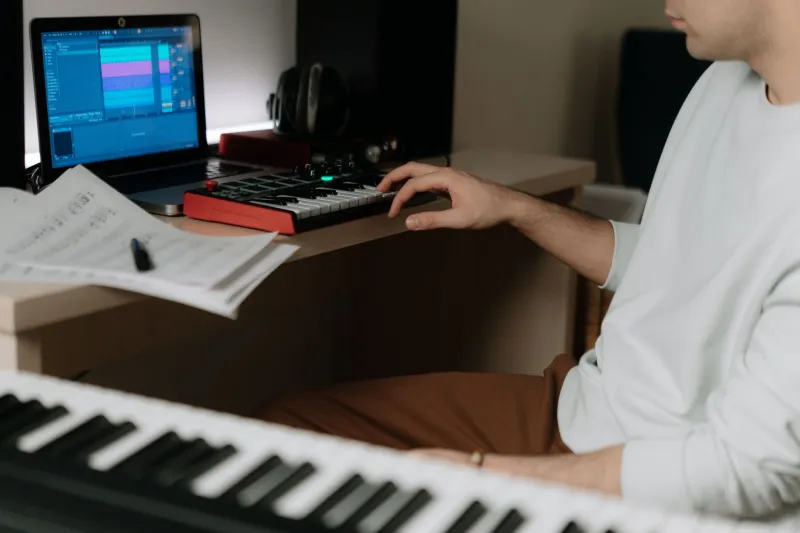
There's a veena loop sitting inside a Billboard-charting producer's session right now, and the artist who recorded it is based in Koramangala. She doesn't know which track it ended up on. She might never find out. But every time someone downloads her sample pack on Splice, a few more dollars land in her account — and her sound travels a little further into a world that's only just starting to pay attention.
This is the new economy of Bangalore music, and it doesn't require a visa, a manager, or a meeting in LA to make it work.
The Sample Pack as a Business Model
For years, Western producers have dominated the sample pack market. Brands like Splice, Cymatics, Loopmasters, and LANDR have historically been stocked with sounds rooted in American and European production traditions — trap hi-hats, UK garage chords, lo-fi jazz chops. The cultural center of gravity was obvious.
That's quietly shifting. A new generation of Bangalore-based creators has figured out that the sounds they grew up with — the ones that felt "too regional" or "too niche" for mainstream consumption — are exactly what producers abroad are hunting for. Carnatic vocal phrases. Tabla patterns recorded in bedroom studios. The ambient texture of a tanpura drone layered under a 140 BPM loop. These aren't novelties. They're becoming staples.
Karthik Rao, a producer and sound designer who operates out of Indiranagar, started selling sample packs in 2021 almost by accident. He'd built a library of original recordings — mostly percussion and strings captured through a mid-range condenser mic in his home studio — and a friend suggested he throw them on Splice as a side experiment.
"The first month, I made maybe forty dollars," Karthik says. "I thought, okay, that's nothing. But then month two was eighty. Month six was close to four hundred. It compounded in a way I didn't expect."
Today, his packs have been downloaded tens of thousands of times. Producers in the US, Germany, and South Korea have tagged him on tracks that used his sounds. He's since released six packs and is working on a collaboration with a Mumbai-based vocalist to create a dedicated Carnatic-influenced vocal chop library.
What Western Producers Are Actually Buying
Spend any time in producer forums on Reddit or Discord and you'll notice the demand is real and specific. Threads asking for "authentic Indian percussion loops" or "South Indian vocal samples" get hundreds of upvotes. The appetite isn't about cultural tourism — it's about sonic differentiation. In a world where everyone has access to the same stock 808s and snare rolls, a well-recorded kanjira loop is genuinely rare.
Meghna Srinivas, a vocalist and producer who splits her time between Bangalore and remote sessions online, has built a small but loyal following on Cymatics by leaning into exactly this gap. Her packs feature processed and unprocessed recordings of her own voice — everything from raw Carnatic ornaments to heavily pitched and chopped phrases designed to drop straight into a DAW.
"American producers especially are very open to it," she says. "They don't always know what they're hearing, technically. They just know it sounds different. It has a quality that their usual go-to packs don't have. And that's the whole point."
She's careful to note that she's not just handing over traditional compositions wholesale. Every sample in her packs is original — inspired by classical training but distinctly her own creation. That distinction matters both creatively and legally, and it's something the more serious Bangalore sample creators are thinking hard about.
The IP Question Nobody Wants to Skip
One of the thorniest issues in this space is intellectual property. Traditional Indian music exists in a complex legal and cultural grey zone — classical ragas are not owned by anyone, but specific compositions and recordings absolutely are. When a producer in Austin downloads a tabla loop and flips it into a trap beat, questions about attribution, licensing, and cultural context start piling up fast.
Most of the Bangalore creators building legitimate businesses on platforms like Splice are navigating this carefully. They record original performances, register their packs under clear licensing terms, and make sure buyers understand what they can and can't do with the sounds. Splice's standard licensing model, for instance, grants buyers broad usage rights for commercial music — which is part of what makes it attractive for producers who want flexibility.
But the broader conversation about how Indian musical heritage gets used, credited, and compensated in global pop music is still very much unresolved. "I want people to use my sounds," Karthik says. "But I also want them to understand where those sounds come from. Even a one-line credit in the liner notes would mean something."
Building a Catalog, Not Just a Pack
What separates the Bangalore creators making real money in this space from those who release one pack and disappear is catalog strategy. The producers thriving on platforms like Splice treat their sound libraries the way a label treats a roster — constantly adding, updating, and cross-promoting.
Meghna releases a new pack every six to eight weeks. She uses Instagram and YouTube to give behind-the-scenes looks at her recording process, which doubles as marketing and as cultural education for producers who might not have context for what they're hearing. Karthik has started bundling older packs together at discounted rates to drive volume downloads and boost his platform rankings.
Both of them are also paying close attention to what's trending in Western production. When a particular sound or mood spikes in popularity — say, a wave of producers chasing that cinematic, orchestral-meets-electronic sound — they think about how their existing recordings might speak to that moment.
"You have to be a producer and a marketer," Meghna says. "The sounds are the product, but the packaging and timing are everything."
Why This Matters Beyond the Money
The revenue angle is real and worth celebrating — independent musicians in Bangalore don't have the same safety nets that artists in wealthier markets do, and passive income from sample packs can meaningfully change what's financially possible. But the cultural impact runs deeper than the dollar figures.
Every time a producer in Detroit or Seoul builds a track around a Bangalore-made sample, they're engaging — however unconsciously — with a musical tradition that's thousands of years old and still very much alive. The sounds of South India are entering global pop music not through a label's international marketing campaign, but through a bedroom studio and a well-designed Splice listing.
For a city like Bangalore, which has always existed at the intersection of the traditional and the ultramodern, that feels exactly right. The sitar doesn't need a co-sign from a major label to end up in a hit record. It just needs the right producer to stumble across the right pack at 2 AM and hit download.
And somewhere in Koramangala, a few more dollars just landed in someone's account.