Load-In at 6 A.M.: What American Tour Managers Are Stealing From Bangalore's Venue Crews
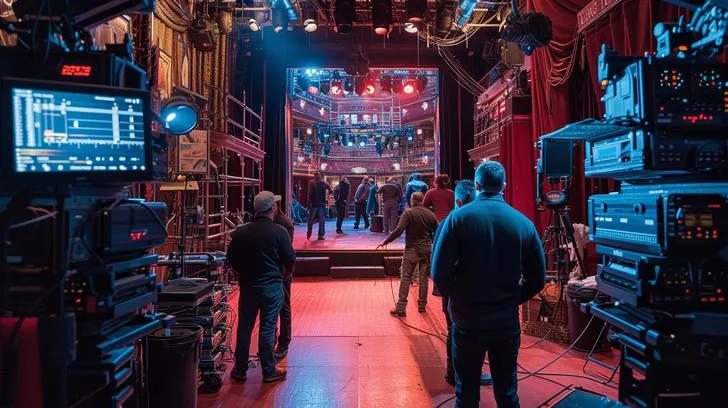
Photo: backstage crew setting up stage lights concert venue load in, via images.stockcake.com
There's a moment that happens in almost every Bangalore venue around 4 p.m. on a show day. The tour manager — often a guy from Minneapolis or Nashville on his first India run — is standing in the wings holding a dead DI box, waiting for someone to tell him where the spare lives. And someone always does. Usually within four minutes. Usually without a radio call.
That moment is where this story starts, because it's the moment where the visiting crew stops treating the local crew like labor and starts treating them like a brain trust. Ask anyone who's worked both sides of the ocean and they'll tell you the same thing: Bangalore's venue crews solve problems American crews would escalate. Not because they're heroic, but because escalation isn't an option when your entire backstage staff is six people and a catering guy who also knows how to re-solder a cable.
The Advance Call Has Eight Voices on It
American touring has spent two decades standardizing the advance — the pre-show phone call where a tour manager walks through load-in times, power specs, rigging points, and hospitality. In the States it's usually two people on the line, maybe three if the venue is nervous.
In Bangalore it's a group chat. Promoter, venue production lead, the guy who owns the PA, a lighting tech who's already pulled the plot, sometimes the artist's local fixer, and a sound engineer who will politely ask what the vocal chain is and then politely ignore the answer.
The visitors find it chaotic for about ten minutes and then they find it efficient. Nothing gets lost because nothing is being relayed through a single exhausted human being at the center. If the tour manager says the drum riser is 8 by 8, three people hear it at once and one of them has already measured the stage.
That's not a Bangalore-only invention. But the density of the city — hundreds of shows a month across rooms of every size, run by people who all know each other — makes the group-chat advance the default. And the American TMs who notice it tend to go home and try to build the same thing in a scene where everyone is used to working through a booking agent's underpaid assistant instead.
Monsoon-Proofing Is a Whole Skill
Here's something you will not hear on a US club tour: 'What's the rain plan for the load-in door?'
In Bangalore you hear it every June. Crews here have spent decades figuring out how to get a backline from a truck into a room when the sky opens up at 6:40 p.m. and the alley floods to ankle depth in eleven minutes. That means risers on pallets. That means cable runs that go over, not under. That means a tarp system designed by someone who has watched a $3,000 keyboard get rained on exactly once and decided never again.
American tour managers fly home with photographs of this stuff. Not because rain doesn't happen in Ohio, but because the outdoor-festival mindset has never fully migrated into the small-club world, and Bangalore's small-club world has never had the luxury of forgetting about weather.
Jugaad Is Not a Shortcut. It's a Line Item.
The word gets translated badly in the US. Jugaad shows up in American writing as 'hack' or 'workaround,' which makes it sound like duct tape and vibes. What it actually looks like in a Bangalore venue is a crew that has priced out what a solution costs and built a version of it that fits the budget without endangering anyone.
A flown lighting truss becomes a ground-supported one with better sightlines. A missing monitor send becomes a repositioned amp and a conversation with the guitarist. A power draw that would trip the breaker becomes a carefully sequenced power-up schedule that the stage manager has memorized.
Is any of that ideal? No. Every production manager here will tell you they'd rather have the proper gear. But there's a difference between cutting corners and engineering within constraints, and American crews who tour small rooms are increasingly living inside constraints too. Club budgets in the US have been flat or falling for years while gear costs climb. The Bangalore approach — solve it locally, solve it fast, document what you did — travels well.
The Team Is Small Because It Has To Be
One of the more jarring things for a visiting TM is the crew call. In a mid-size US room you might have a stage manager, two stagehands, a monitor engineer, a front-of-house engineer, a lighting op, a runner, and a security lead. In a comparable Bangalore room you might have four of those roles and two people doubling up.
What that produces is a crew where everybody knows everybody else's job. The lighting op can patch a vocal. The runner knows the breaker panel. Nobody stands around waiting for the person whose job it technically is, because there is no such person.
American tour managers describe this as 'refreshing' for the first two hours and 'terrifying' for the next two, as they realize how much of their own operation is built on the assumption that someone else will handle it.
What US Club Tours Could Actually Take Home
Stripped of the romance, the transferable lessons are boring and useful:
- One channel, many ears. Build a single show-day thread that includes production, not just the promoter and the TM. Relay chains lose information.
- Weather is production. Even indoor shows. Have a wet-load plan before the truck arrives.
- Name your constraints out loud. Bangalore crews are unembarrassed about budget. American crews treat it as a secret, then improvise badly at the last minute.
- Cross-train the two youngest people on the crew. They're the ones who'll be running the room in five years.
- Write down the fix. The best venue crews here keep a notebook — literal, paper, in a drawer — of what broke and how they solved it.
The Part That Doesn't Transfer
It would be dishonest to present this as a model America should import wholesale. Bangalore's crews operate under pressure that American crews shouldn't romanticize: tight margins, expensive gear, unpredictable infrastructure, and a touring-visa environment that makes international routing genuinely hard. Nobody backstage is doing jugaad because it's charming. They're doing it because the alternative is not doing the show.
But there's a genuine exchange happening, and it runs both directions. American TMs bring documentation habits, safety culture, and a respect for load-in schedules that Bangalore crews have started adopting. Bangalore crews send visiting managers home with a working theory that a small team that trusts itself can outrun a big team that doesn't.
Watch the next wave of American club tours — the 300-cap rooms, the support slots, the runs that never touch an arena. A lot of them are going to be staffed leaner and advanced harder than the tours that came before. Some of that thinking got picked up in a Bangalore wing at 4 p.m., standing next to a dead DI box.