Why Serious American Producers Are Packing Up Their Plug-Ins and Landing in Bangalore
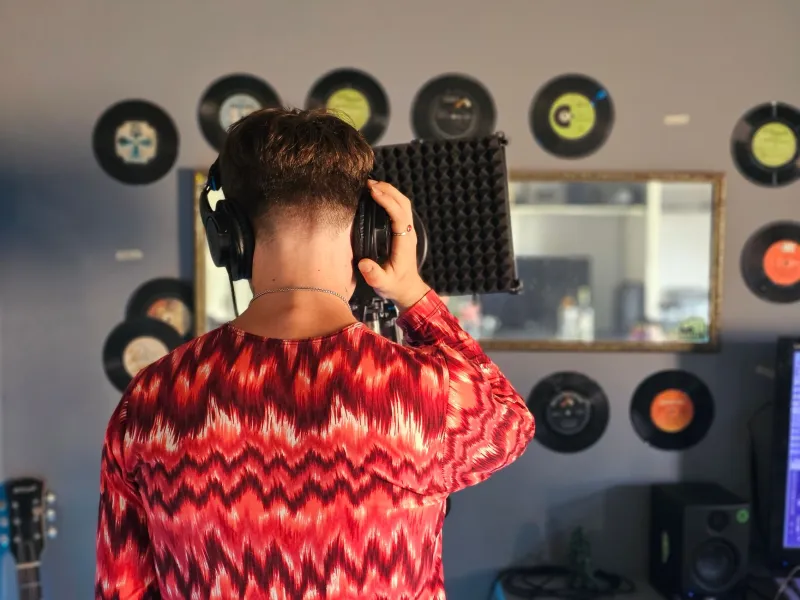
For decades, the music industry ran on a single gravitational pull. You grind in your hometown, you save up, and eventually you make the pilgrimage west — to LA, to the Valley, to those iconic studios where the walls practically hum with Grammy history. The fantasy was always the same direction. Until now.
A quiet but undeniable shift is happening, and it's moving in reverse. Established American producers — people with real credits, real gear, and real options — are landing in Bangalore and staying. Not for a week-long session or a cultural tourism trip. They're setting up shop, signing leases, and plugging into a creative ecosystem that LA, for all its mythology, simply cannot replicate right now.
The Math Nobody in the Industry Wants to Say Out Loud
Let's start with the numbers, because they're genuinely staggering. A mid-tier recording studio in Los Angeles — not a legendary room, just a solid professional space with decent gear — will run you anywhere from $150 to $500 per hour depending on the neighborhood and the engineer attached. Book a week of serious production time and you're looking at a budget that would make most independent artists physically ill.
In Bangalore? Comparable studio time — and we're talking acoustically treated rooms with modern outboard gear and engineers who actually know what they're doing — runs a fraction of that cost. Producers who've made the move describe the difference as almost disorienting at first. You budget for what you're used to spending, and then you realize you have money left over. Real money. The kind that lets you experiment, rent extra session musicians, try a take sixteen times instead of four, and actually chase the sound in your head rather than the sound you can afford.
Beyond studio rates, the cost-of-living math is just as compelling. A genuinely comfortable apartment in Indiranagar or Koramangala — two of Bangalore's most creatively vibrant neighborhoods — costs a fraction of what a comparable place in Silver Lake or East Hollywood would run. That's not a minor lifestyle upgrade. For a freelance producer working project to project, that gap between rent and income is the difference between creative freedom and a side hustle that's slowly eating your soul.
Sonic Inspiration That LA Literally Cannot Manufacture
But here's the thing: the financial argument, compelling as it is, isn't actually what's driving the most interesting producers to make this move. The ones who are staying — who are genuinely building something here rather than just cutting costs — are talking about something harder to quantify.
Bangalore's musical DNA is unlike anything you'll find in a Western city. The city sits at a crossroads where Carnatic classical tradition, Hindustani influences, Kannada folk forms, and a hyper-modern electronic scene are all operating simultaneously and bleeding into each other constantly. For a producer who's spent years chopping the same sample libraries and chasing the same trending sounds as everyone else on their block, landing in the middle of that is genuinely disorienting in the best possible way.
One producer who relocated from the San Fernando Valley described his first six months in Bangalore as "like getting my ears reset." He'd been working in hip-hop and R&B for over a decade, and he was good at it. But he'd started to feel like he was making music by formula — recognizing patterns, executing them efficiently, and moving on. Bangalore broke that pattern. The rhythmic structures in South Indian classical music alone rewired how he was thinking about groove and time signature. He came back to his sessions with ideas he genuinely couldn't have generated anywhere else.
The Talent Pipeline That Changes the Whole Conversation
There's another dimension to this story that doesn't get enough attention: the sheer depth of untapped musical talent concentrated in Bangalore right now.
The city has a robust classical music education infrastructure that's been producing technically elite musicians for generations. It also has a younger generation of producers and artists who grew up absorbing both that tradition and the full weight of global pop, hip-hop, and electronic music through streaming. The result is a cohort of musicians who can sight-read a complex Carnatic composition and then turn around and program a drill beat that would hold up in any London or Chicago context.
For American producers who are used to working in established markets where session musician rates are high and everyone's schedule is packed, tapping into Bangalore's talent pool feels like discovering a cheat code. The collaboration opportunities are genuine and the creative openness is real — local artists are hungry for cross-cultural exchange in a way that goes beyond novelty. They're not interested in being someone's "exotic influence." They're interested in building something that neither side could make alone.
The Infrastructure Is Catching Up Fast
Skeptics will point out, not unfairly, that Bangalore's music infrastructure has historically been patchy. Internet reliability, equipment availability, and the logistics of running a professional session from a city that's still developing its music industry ecosystem — these are real concerns, and anyone who's spent time here will tell you they're not entirely resolved.
But the trajectory matters more than the current snapshot. Investment in studio infrastructure in Bangalore has accelerated significantly over the last several years. New professional facilities have opened, existing ones have upgraded, and the local engineering talent pool has deepened as a result. Producers who arrived three years ago and dealt with real logistical friction are reporting that the experience today is meaningfully smoother.
High-speed fiber is increasingly available in the neighborhoods where creative professionals tend to cluster. Remote collaboration tools have matured to the point where a producer in Bangalore can co-write and share sessions in real time with a label A&R in New York without the process feeling like a compromise. The friction is still there in places, but it's no longer the dealbreaker it once was.
What This Means for the Industry's Center of Gravity
The music industry has always had geographic centers of power — cities where the money, the connections, and the culture concentrated until they became self-reinforcing magnets. Nashville, New York, LA. Those centers aren't disappearing. But they're no longer the only option for serious professionals who want to do serious work.
Bangalore is building a case for itself not as an alternative to those cities but as something genuinely different: a place where the creative math adds up differently, where the sonic raw material is richer and stranger, and where the window of opportunity for early movers is still wide open.
The producers who are figuring this out now — who are willing to get on a plane and spend a few months actually living inside Bangalore's music scene rather than just reading about it — are going to have an advantage that's very hard to replicate later. The sound they're building access to, the relationships they're forming, the creative instincts they're developing by working in a genuinely unfamiliar musical environment: that's not something you can shortcut.
LA will always have its mythology. But Bangalore? Bangalore has momentum. And right now, those might not be the same thing.